


Part of the SiteMap Series
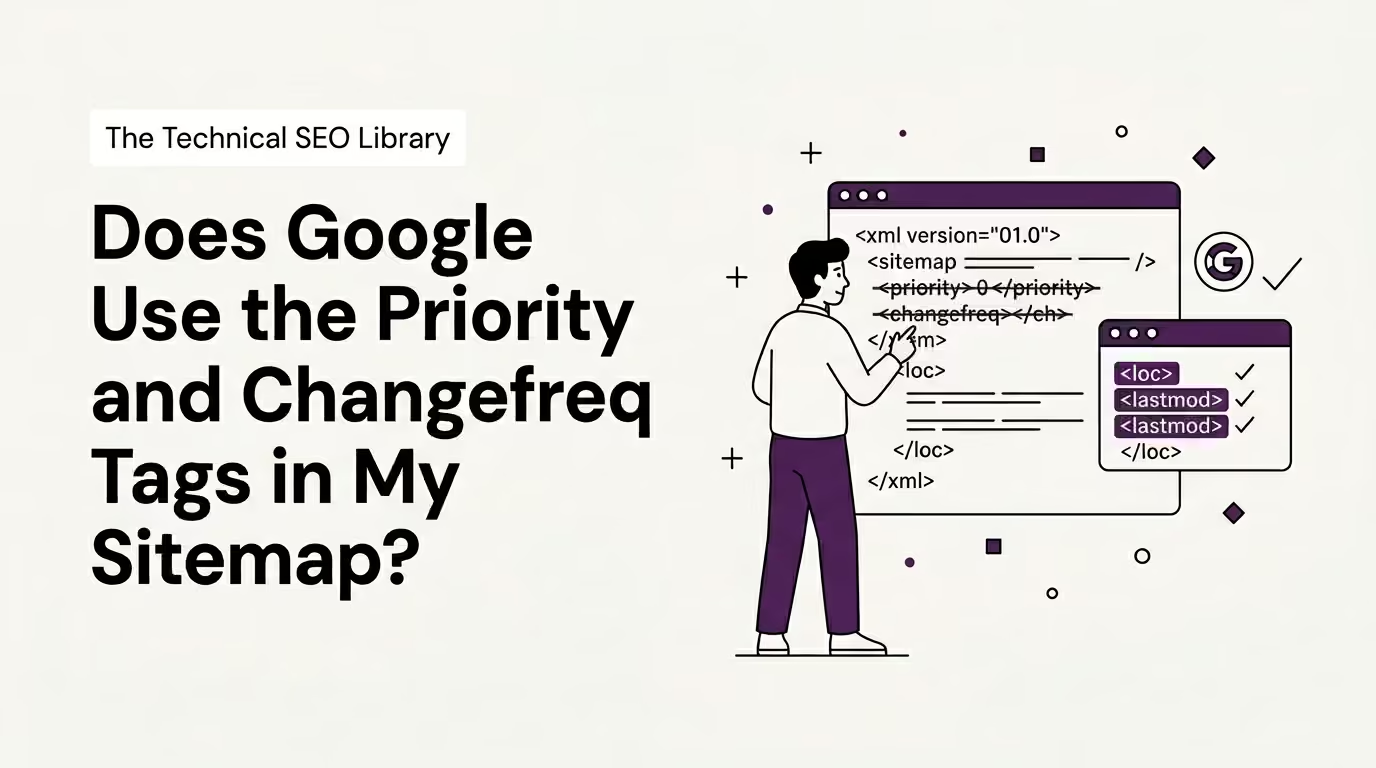
No. Google ignores both the priority and changefreq tags in XML sitemaps. The two signals Google actually uses from the sitemap are loc (the URL itself) and lastmod (the last modified date). John Mueller and Gary Illyes have both confirmed publicly that priority and changefreq do not influence Google’s crawling, indexing, or ranking decisions. The tags remain in the sitemap protocol for historical reasons; they were defined in 2005 when search engines had less sophisticated crawl scheduling and relied more heavily on publisher hints.
If you have been setting priority values across your sitemap or specifying changefreq for different URL types, you can stop. The effort has not been doing what you think it has.
This FAQ covers what Google has actually said about these tags, what Google does pay attention to in a sitemap, why these tags exist in the protocol if Google ignores them, what other search engines do with them, and whether to keep or remove them.
What Google has actually said
The position is not interpretation; it is direct statement from Google.
John Mueller has confirmed on multiple occasions, in Webmaster Hangouts and on social media, that Google does not use the priority tag in sitemaps. Gary Illyes has confirmed the same about changefreq. The official Google Search documentation reflects this: priority and changefreq are described as supported syntax but with explicit notes that Google does not use them for ranking or crawl prioritisation.
The reason is operational rather than ideological. When publishers set their own priority and changefreq, the values are notoriously inaccurate. Most sites either leave them at defaults or set every URL to priority 1.0 and changefreq daily. Either way, the values do not contain useful signal that Google’s own systems cannot derive better from observed behaviour.
What Google actually uses from the sitemap
Two fields carry weight.
<loc> (the URL itself). The most important signal. Including a URL in the sitemap signals that the publisher considers it canonical and worth indexing. URLs in sitemaps get crawled with higher priority than URLs only discovered through internal links.
<lastmod> (the last modified date). Used by Google as a re-crawl priority signal, but only if Google trusts the lastmod values. Accurate lastmod (updated only when content genuinely changes) earns trust over weeks and months. Inaccurate lastmod (bumped on every build or set to the current time) gets discounted, and Google falls back to its own crawl scheduling.
Beyond loc and lastmod, the standard sitemap tags do not carry meaningful weight with Google. The specialised extensions (<image:image>, <video:video>, <news:news>) do matter where applicable, but those are different markup, not priority or changefreq variants.
Why the priority and changefreq tags exist at all
The XML sitemap protocol was published in 2005 as a collaboration between Google, Yahoo!, and Microsoft. At the time, search engines had less sophisticated crawl scheduling and relied more on publisher hints. Priority and changefreq were intended as those hints.
Twenty years later, the picture is different. Search engines have far better crawl intelligence based on observed user behaviour, link patterns, content freshness, and many other signals. Publisher-declared priority and changefreq are weak signals compared to what the crawlers can derive themselves, so the major search engines either ignored these tags from the start or stopped using them as their systems matured.
The protocol still includes them because the sitemap protocol is a stable standard. Removing fields from a published standard breaks backwards compatibility and creates more problems than it solves.
Do other search engines use them?
The position varies, but the practical effect is similar.
Bing. Bing’s official position is that it may use changefreq as one input among many, but with little weight. Priority is largely ignored. Bing’s documentation acknowledges the tags exist but does not promise specific behaviour.
Yandex. Yandex has historically used priority and changefreq more than Google does, but with declining weight in recent years.
AI crawlers (GPTBot, ClaudeBot, PerplexityBot). Available documentation suggests these crawlers, where they use sitemaps at all, focus on loc and lastmod. There is no public indication that priority or changefreq affect their behaviour.
The overall picture: no major search engine treats priority or changefreq as a strong signal in 2026.
Should you keep them in your sitemap?
There is no technical harm in keeping them, but there is no benefit either. Three considerations apply.
For file size: Removing priority and changefreq across a large sitemap can meaningfully reduce file size. On a sitemap with 50,000 URLs, this can save several megabytes of XML.
For maintenance: Keeping accurate values requires ongoing work that delivers no return. The simpler the sitemap, the easier it is to maintain.
For signal clarity: A clean sitemap that contains only loc and lastmod sends a focused signal to crawlers. A sitemap stuffed with priority 1.0 and changefreq daily on every URL signals nothing useful and may actually look amateurish in a quick audit.
The practical recommendation: omit priority and changefreq from new sitemaps. For existing sitemaps that include them, removing them is a low-priority cleanup but worth doing when you next regenerate the file.
What about the few sites that genuinely vary changefreq?
Some sites have legitimate variation: a homepage that updates several times per day, blog posts that rarely change after publication, evergreen reference content that never changes. The instinct to encode this variation in changefreq is understandable.
The honest position: even when the variation is real and accurately encoded, Google does not use it. The variation is encoded better through accurate lastmod values. A URL with a recent lastmod gets re-crawled more frequently than a URL with a stale lastmod, regardless of what changefreq says.
So even when you would have something useful to communicate, the better channel is lastmod accuracy, not changefreq.
Where this leaves us
If you have been carefully maintaining priority and changefreq values, you can stop and reallocate the time to keeping lastmod accurate, which is the signal that actually carries weight.
For the full treatment of why Google ignores these tags, including the documented history and the implications for sitemap generation, see Does Google Use Priority and Changefreq?. For what each XML sitemap element does in practice, see What Each XML Sitemap Element Does.
This is an entry in Module 5: Sitemap FAQs, part of The Sitemap Series, a Technical SEO series on sitemaps from first principles, built for the AI Search era.