

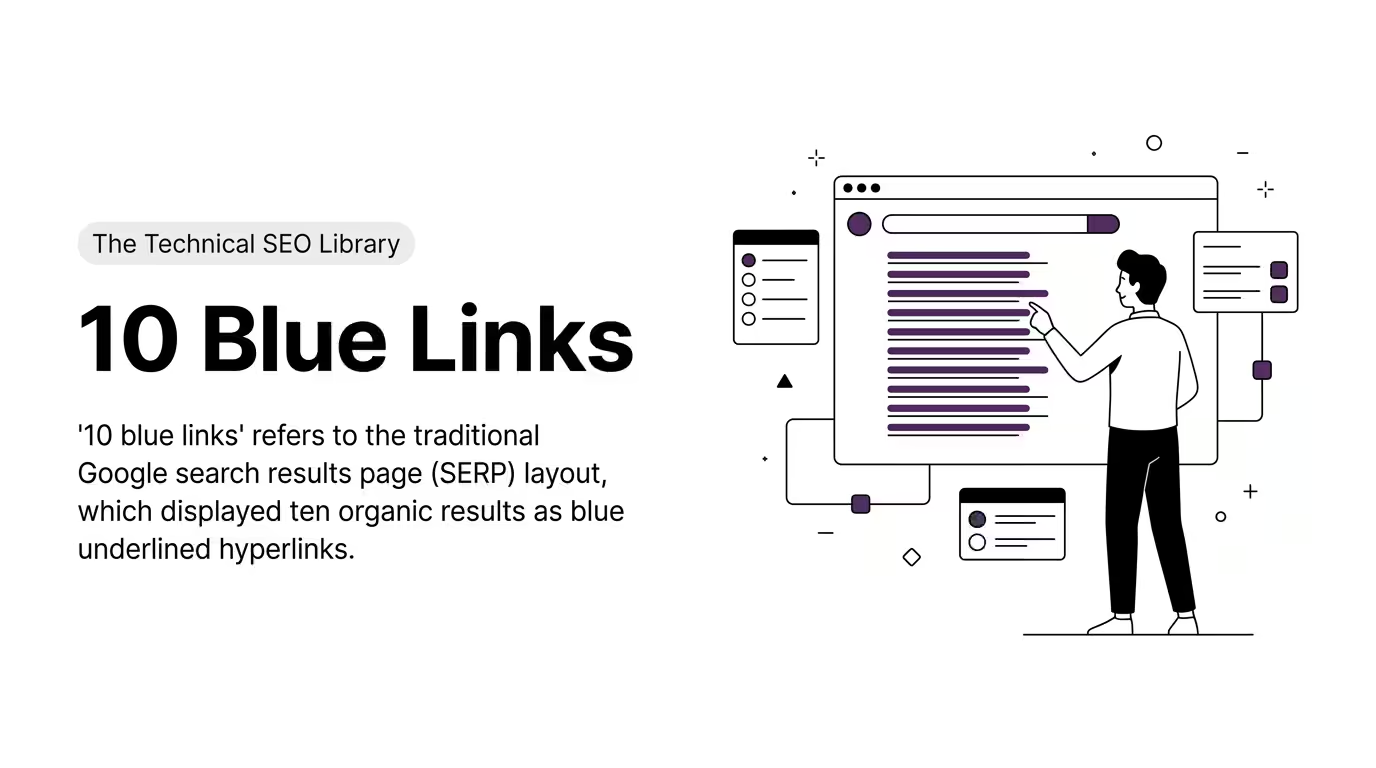
“10 blue links” is the informal name for the classic Google search results page format, where a query returned a list of ten organic results displayed as blue underlined hyperlinks. This layout defined how people interacted with the web and how SEO was practised for most of the search engine era. As Google’s results page evolves toward AI overviews, knowledge panels, and richer interactive features, the 10 blue links format is increasingly being supplemented or replaced.
Key Takeaways
A quick view of what 10 blue links means and why the term still matters:
- “10 blue links” refers to the traditional Google search results page (SERP) layout, which displayed ten organic results as blue underlined hyperlinks.
- The format dominated from Google’s launch in 1998 through the mid-2010s, defining how SEO was understood and practised.
- Modern SERPs now include AI Overviews, featured snippets, knowledge panels, local packs, and other elements that compete with or push down the original 10 links.
- Understanding the 10 blue links era is essential context for understanding why SEO is changing in the AI search era.
- The phrase is often used by senior SEOs to describe what search used to be and what it is no longer.
Understanding the 10 Blue Links
In its original and longest-running form, a Google search results page showed exactly ten organic results per page. Each one was presented the same way: a blue underlined link, a green URL beneath it, and a short snippet of grey text describing the page. Below the tenth result, you would see “Goooooogle” with the option to load the next ten.
That design defined what a search result looked like. The blue underlined link was the default state of every clickable web text in the early web era, and Google’s SERP simply reflected that convention. Over time, the visual softened, the underlines disappeared, and the colour shifted, but the term stuck. “10 blue links” became shorthand for the entire traditional SERP format.
For SEO professionals, that format was the whole game. Every keyword had a top ten. Every strategy was a contest for one of those ten slots. Every analytics dashboard tracked rankings within that frame.
The Origin of the 10 Blue Links
Google was not the first search engine to display ten results per page, but it was the one that made the format universal.
When Larry Page and Sergey Brin launched Google in 1998, the design was deliberately minimal: a logo, a search box, and a results page. The choice of ten results emerged from Google’s early design decisions. Showing more would have slowed page loads on the dial-up connections of the late 1990s. Showing fewer would have felt sparse compared to competitors like AltaVista and Yahoo, which were already crowded with banner ads and directory navigation.
Ten results per page also gave a clean visual rhythm. The user could scan all ten at a glance, and the pagination at the bottom invited them to load more if needed. Click data from those early years confirmed the format worked, and Google held onto it for over fifteen years.
What the 10 Blue Links Looked Like
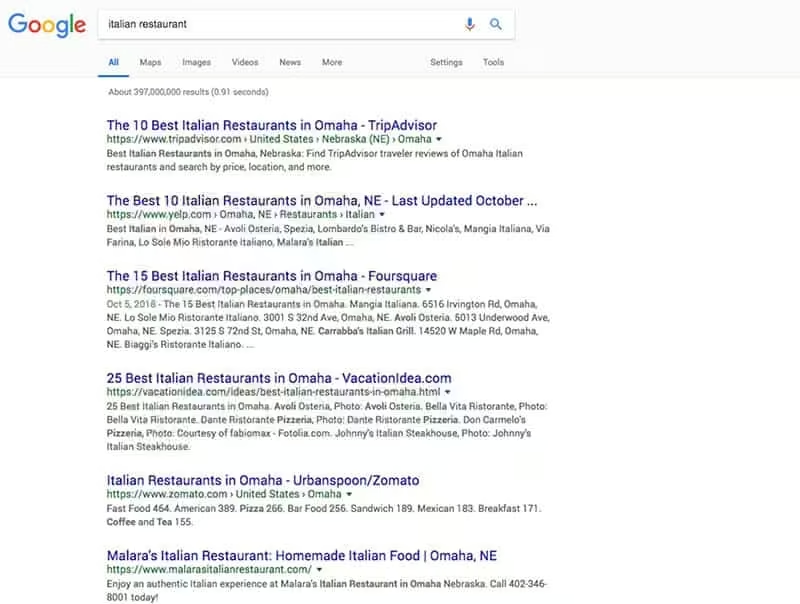
The visual anatomy of a 10 blue links page was simple and consistent across the years.
Each result included the page title shown as a blue clickable hyperlink, the URL of the page in green below the title, and a short snippet of black or grey text drawn from the page’s meta description or content. Some results had additional features like a date, a star rating, or breadcrumb navigation, but most followed the standard title, URL, and snippet layout.
Sponsored results (ads) were sometimes mixed in, but they were originally separated to the right of the page or marked clearly with a coloured background. Google later integrated paid and organic results more tightly into the same column, but the underlying 10 blue links structure remained.
Why the 10 Blue Links Era Defined SEO
For over fifteen years, almost every SEO strategy was a contest for those ten slots. The disciplines of ranking, keyword research, link building, on-page optimisation, and content strategy were all built around the goal of placing a page within the top ten.
The reason was simple economics. Studies of click-through rates from that era showed that the first result on Google typically captured around thirty per cent of clicks. The second got about fifteen per cent. The third is around ten per cent. By the time you reached the bottom of page one, you were fighting for two or three per cent. Page two collectively earned almost nothing.
The result was a ranking economy. Tools like Ahrefs, Moz, and Semrush built entire dashboards around tracking your position in the top ten. SEO agencies sold their services in terms of “first page rankings”. The whole industry shared a single mental model: there are ten slots, and your job is to be in them.
Whatever else SEO has become, that mental model still influences much of the industry’s vocabulary, tooling, and assumptions.
The End of the 10 Blue Links Era
The 10 blue links page did not disappear suddenly. It eroded gradually, decade by decade, as Google added new types of results above and beside the organic list.
In 2007, Google introduced Universal Search, which mixed images, videos, news, and other content types into the main results column. In 2012, the Knowledge Graph began displaying fact boxes for entities such as people, places, and concepts to the right of the results. Featured snippets, often called “position zero”, arrived in 2014, pulling a direct answer above the first organic link. People Also Ask boxes followed. Local search developed its own three-pack. Advertising expanded to take up more space above and below the organic list.
By the early 2020s, a typical SERP for a popular query might show two or three ads at the top, a Knowledge Panel on the right, a Featured Snippet, a People Also Ask box, a local pack, an image carousel, and only then the first organic blue link. The “10 blue links” were still there, but they had been pushed down the page, sometimes well below the fold.
The arrival of Google’s AI-generated answers in 2023, expanded under the AI Overviews name in 2024, accelerated the change. AI Overviews can occupy the entire top of the SERP, summarising the answer to a query directly and citing only a handful of sources. For some queries, especially informational ones, the user gets an answer without ever having to scroll or click through. This pattern, often called zero-click search, has accelerated as AI overviews expand.
This is what people mean when they say “the 10 blue links era is ending”. The format is not gone, but it is no longer the centre of how users interact with search.
10 Blue Links vs The Modern SERP
The shift from 10 blue links to today’s SERP is easier to understand side by side.
The traditional 10 blue links SERP had a single column of ten organic results, with paid results sometimes mixed in or shown separately. The user scanned, clicked, and got their answer by reading the destination page. The SEO goal was clear: be one of those ten.
The modern Google SERP has multiple zones. At the top, an AI overview may answer the question directly. Below that, ads. Below those, sometimes a Featured Snippet, a People Also Ask box, an image carousel, video previews, a knowledge panel beside the column, and possibly a local pack. The organic 10 blue links sit further down, often only the first three or four are visible without scrolling. On some queries, the user never sees them at all.
The SEO goal has expanded accordingly. Ranking in the organic ten is still useful, but it is no longer the only place to be visible. You can also be:
- Cited inside an AI Overview without ranking traditionally
- Featured in a People Also Ask box
- Pulled into the Featured Snippet
- Shown as a Knowledge Panel entity
- Included in a video carousel or image pack
This is what the AI search era SEO is really about. The 10 blue links are one surface among many.
Common Misconceptions
The phrase “10 blue links” is used in a handful of contradictory ways. Two are worth clearing up.
“Google still shows 10 blue links by default.”
Mostly true on paper, but misleading in practice. Most queries on desktop or mobile still return a list of organic results that includes ten links per page, but they are increasingly buried below AI Overviews, ads, snippets, and other features. For many queries, the user never reaches them.
“AI Search will completely replace the 10 blue links.”
Not quite. Some queries, especially navigational and transactional ones, still favour direct links. AI search is reshaping the informational and conversational query space, but the traditional organic link will continue to exist for some time, just sharing the space with new formats.
Frequently Asked Questions
A few specific questions about the 10 blue links term come up often enough to be worth answering directly.
Why are they called blue?
Because the standard styling for a clickable hyperlink in early web design was blue and underlined. Google’s results page reflected the convention, and the term became shorthand for the entire format. Modern SERPs use a different shade and no underline, but the phrase has stuck.
Why ten results per page?
The original choice was partly technical (showing more would have slowed page loads in 1998) and partly aesthetic (ten gave a clean, scannable rhythm). Other search engines used different numbers, but Google’s ten became the default.
Does Google still show ten results per page?
Mostly, yes, for the organic portion. But the organic ten are now sharing the SERP with AI overviews, ads, snippets, knowledge panels, and other features. On many queries, the ten organic results are no longer the most visible part of the page.
Is “10 blue links” the same as “page one”?
In the original Google SERP, yes. Page one was the first set of ten results. Modern SERPs blur the line because they include so many non-link elements, but the phrases “page one” and “10 blue links” still refer to the same era.
Is this still a useful term to know today?
Yes, especially in a technical SEO context. Senior SEOs use it to describe what search used to be. Newer SEOs need to know it to understand the conversations happening about the AI search transition. It is also the natural starting point for any discussion of how Google’s SERP has changed since launch.
« Back to Glossary Index