


Last week, Google published an official guide on optimising for generative AI search. Within days, every SEO publication had a take. LinkedIn lit up. Twitter threads multiplied. The general feeling across the industry was that Google had just settled the GEO debate by declaring that GEO is “just SEO” and that all the special tactics people had been recommending for AI search were unnecessary.
I read the guide carefully this week. The story is more interesting than the discourse around it.
If you are new to this conversation, here is the quick context. SEO stands for Search Engine Optimisation, the work of helping your website show up in Google. GEO stands for Generative Engine Optimisation, the newer work of helping your website show up in AI tools like ChatGPT, Perplexity, Copilot, and Gemini. AEO (Answer Engine Optimisation) is a related term used in the same space.
The question the industry has been arguing about is whether GEO is genuinely a different discipline that requires different work or whether it is just SEO with a new acronym. Google appears to have weighed in on the side of “it is just SEO”. The reality, when you read the actual document, is more nuanced.
The contradiction worth noticing
Here is the strange part. Around a month before Google published this guide, they posted a senior job opening on their careers page. The role was specifically focused on managing the GEO ecosystem, shaping how GEO players prioritise Google’s surfaces, and leading C-suite GEO strategy. The phrase “Generative Engine Optimisation” appears in the job description itself.
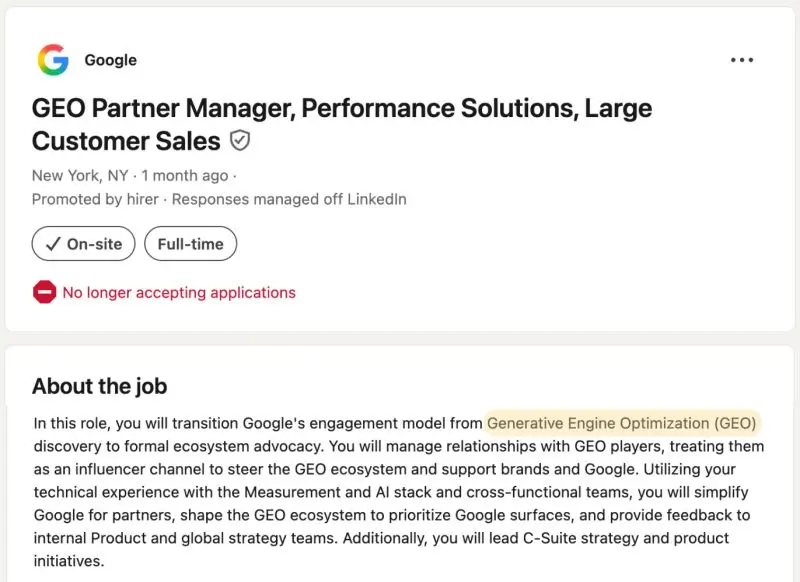
So on one hand, Google’s public documentation tells the market that GEO and AEO are unnecessary distinctions. On the other hand, Google’s hiring team is actively recruiting a senior leader to manage GEO as a strategic discipline.
Both positions cannot be true at the same time. One of them is what Google thinks internally. The other is what Google wants the market to think.
This contradiction is the first thing worth holding onto as you read what comes next.
What Google actually wrote (read carefully)
Here is the key passage from the documentation, word for word:
“AEO” stands for “answer engine optimisation”, and “GEO” for “generative engine optimisation”. These are both terms you may see used to describe work specifically focused on improving visibility in AI search experiences. From Google Search’s perspective, optimising for generative AI search is optimising for the search experience and thus still SEO.
Read that bolded sentence again. The four words that do the most work are “From Google Search’s perspective”.
Google is not saying GEO does not exist as a discipline. Google is saying that from their own viewpoint, looking at their own AI search features (AI Overviews and AI Mode), optimising for them is still SEO. That is a much narrower claim than the discourse has been treating it as.
Later in the same guide, when Google lists tactics you can ignore, they introduce the list with this line: “Here are a few things you can ignore for Google Search.”
Again, scoped to Google Search. Not to AI search in general.
What is being repeated (and the gap)
The LinkedIn takes I read after this guide came out told a slightly different story. Several popular posts said Google “debunked” GEO tactics and “dismissed” GEO as a separate discipline. The way they phrased the conclusions quietly dropped the qualifiers Google had carefully written in.
Three examples worth knowing.
- On structured data: Google actually wrote that structured data “isn’t required” for generative AI search but added that “it’s a good idea to continue using it as part of your overall SEO strategy.” Several LinkedIn breakdowns summarised this as “Google says structured data doesn’t matter. “That is not what Google said. They said it is not required but recommended that you keep using it.
- On third-party mentions: Google wrote that “seeking inauthentic ‘mentions’ across the web isn’t as helpful as it might seem”. The keyword in that sentence is ‘inauthentic’. Google did not dismiss the value of being mentioned by other websites. They dismissed the value of faking mentions. The popular summaries dropped the word “inauthentic” entirely, which changes the meaning completely.
- On the GEO term itself: As we saw above, Google said “from Google Search’s perspective”. The popular summaries treated it as a universal claim about how AI search works everywhere.
The pattern is the same in each case. Google scoped carefully. The discourse dropped the scoping. The result is a much more aggressive claim than Google actually made.
Why this matters for anyone working in search
If you are new to SEO, this might feel like splitting hairs. It is not.
ChatGPT, Perplexity, Copilot, and Gemini do not read the web the same way Google does, and they do not read it the same way as each other. They have different ways of finding pages, different sources they trust, and different reasons for choosing which pages to cite when answering a question.
To give you a quick sense of why this matters:
- ChatGPT pulls heavily from Bing’s index and tends to favour Wikipedia, Reddit, and LinkedIn as trust sources.
- Perplexity runs its own independent index and prefers content updated in roughly the last 30 days.
- Gemini overlaps with Google in some areas but diverges in others.
- Copilot blends Bing with its own retrieval layer.
The practical consequence is that the same blog post can rank in Google’s top 10 and pick up zero citations from ChatGPT. Or pick up Perplexity citations while being invisible to Gemini. The traditional SEO checklist does not tell you why this happens. You have to think about each platform as its own optimisation problem, sitting on top of the same SEO foundation.
That is not SEO with a rebrand. It is a separate strategic layer on top of SEO. And Google’s documentation, even read in the most charitable way, only addresses one of those four platforms.
The part of the work Google’s guide does not cover
There is a deeper issue underneath the tactical debate. Most teams do not even know which AI tools are currently visiting their website. That sounds strange, but it is true.
Quick explainer if you are new to this. Every time a bot visits your website (whether it is Google’s crawler indexing pages or ChatGPT’s bot pulling content for an answer), it leaves a fingerprint in your server’s records. These records are called server logs or log files. They are a list of every visit your site received and which “user agent” (the identifying name) made the visits.
The AI tools have public user agents you can look for in your logs:
- GPTBot is OpenAI’s crawler for ChatGPT.
- PerplexityBot is Perplexity’s crawler.
- ClaudeBot is Anthropic’s crawler for Claude.
- OAI-SearchBot is OpenAI’s crawler specifically for ChatGPT search results.
- GoogleOther is one of Google’s specialist crawlers.
Most SEOs are not checking their logs for these. The tools used by the average SEO team are tuned primarily for Googlebot, so the other crawlers slip through unmonitored. That means most teams cannot answer basic questions like “Is ChatGPT actually reading my site?” or “which of my pages does Perplexity prioritise?”
If you cannot see who is reading your site, you cannot optimise for them. The diagnostic work has to come before the tactical work. And almost nobody is writing about it.
What you can actually do, starting this week
If you want to take the GEO question seriously without waiting for the industry’s tools to catch up, here is where to begin.
- Pull your server logs from the last 30 days and filter by user agent. Look specifically for GPTBot, PerplexityBot, ClaudeBot, OAI-SearchBot, and GoogleOther. Note how often each one visits, how deep they go into your site, and which URLs they prioritise. The patterns will look different from Googlebot’s, and that difference tells you something useful about where you sit in each platform’s view.
- Audit your schema against what each platform actually reads, not just what Google validates in Search Console. If you do not know what schema is, it is structured code you add to a page to help search engines and AI tools understand what the page is about (a product, a recipe, an article, a person, and so on). Different platforms support different schema vocabularies and ignore others. FAQ schema, for example, was deprecated by Google for rich results but is still being consumed by ChatGPT in noticeable amounts.
- Check your llms.txt status. Without going too deep, LLMs.txt is a relatively new file format designed to tell AI tools what content on your site they should prioritise. Google’s documentation says you do not need it for Google. Several other platforms do read it. Absence is itself a signal.
- Measure citation presence on each platform where measurement is possible. Perplexity makes this relatively easy because their citations are visible. ChatGPT is harder but doable through structured prompt testing at scale.
Wrapping up
If Google genuinely believed GEO was just SEO in the way the documentation suggests, the senior strategist role would not exist. The internal recognition of GEO as a discrete discipline is, in my view, the most credible Google source on the question. It is just not the source Google is putting in front of the market.
The official documentation describes Google’s public position. The hiring page describes what Google actually believes. When those two disagree, the hiring decision is the one to trust.
GEO builds on SEO foundations, yes. But the platforms it spans are multiple, the trust signals on each platform are different, and the diagnostic work it requires is largely unaddressed by the current toolkit. That makes it a distinct strategic discipline, regardless of which Google page you read.
The rest of the work is still there, waiting to be done. Most of it starts in your server logs.